
90 days. Off every grid.
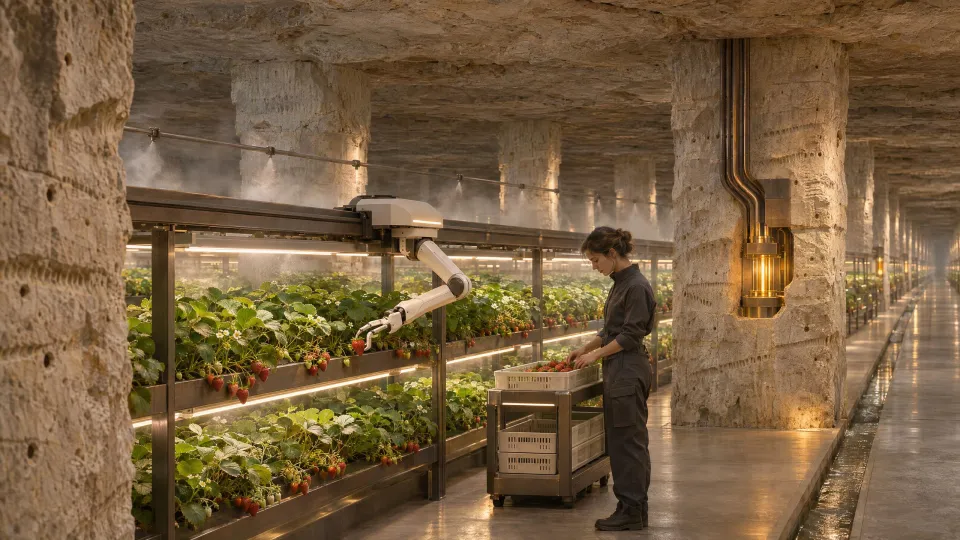
Food grows under light on floor one, in the rock.
Greens and strawberries, picked by machine every day.
 Next: water
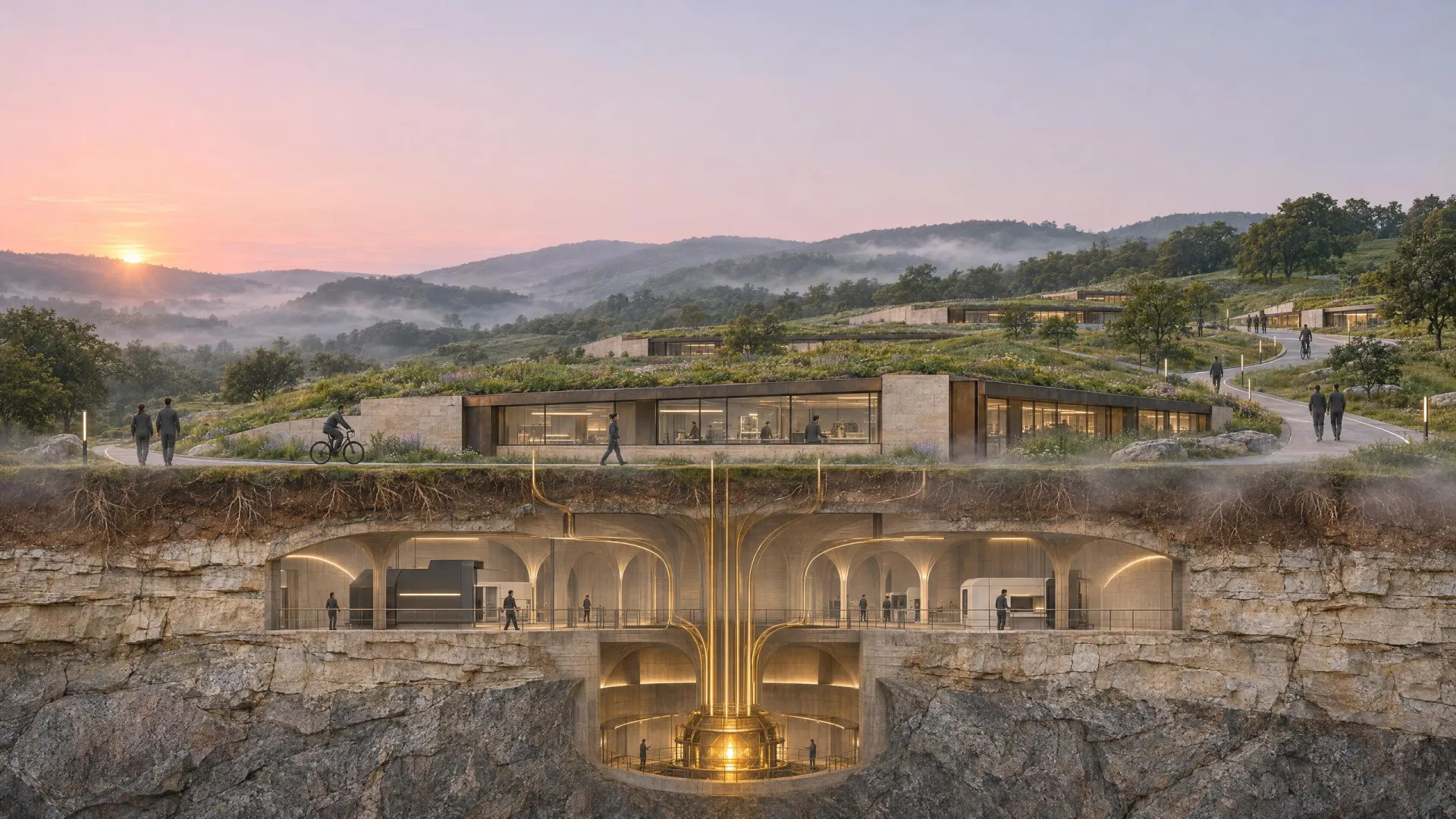
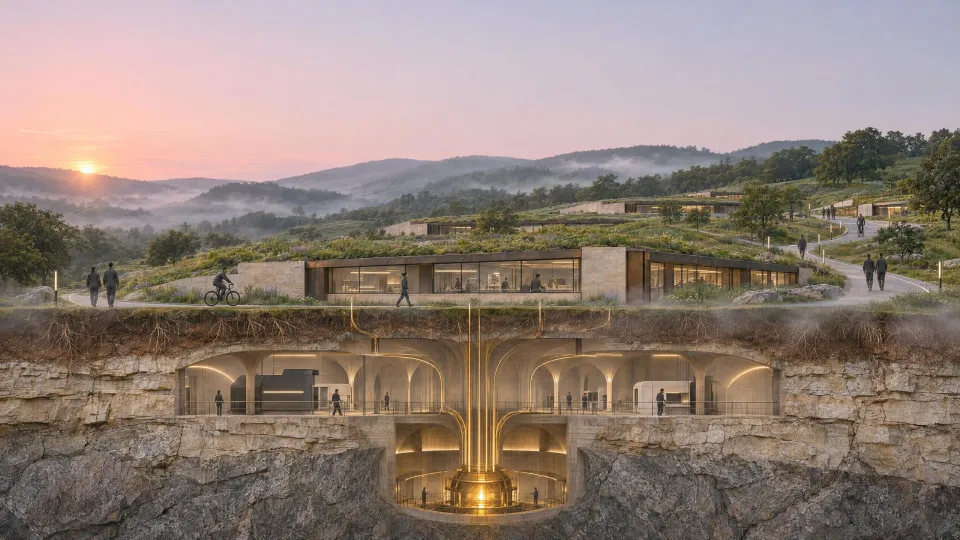
A concept for the American installation of the next century: its own reactor a thousand feet down, ninety days off every grid, and a place people want to live on top.
Watch the teaserThe nose is all that shows above ground. Below it, cut into the rock, are two floors, a hangar along the trailing edge and a shaft down the middle.
Humanoid robots load low, cabless carriers, and the carriers follow the gold line to every level. Two people check the manifest.
Greens and strawberries grow in tiers under warm light, and arms on rails do the picking. Food for ninety days, grown in the rock.
The gap down the middle of the mark is a lift shaft. Every floor opens onto it, and it runs on down a thousand feet to the core.
The room everyone shares: one long table under brass pendants, and a wall of glass onto the hills.
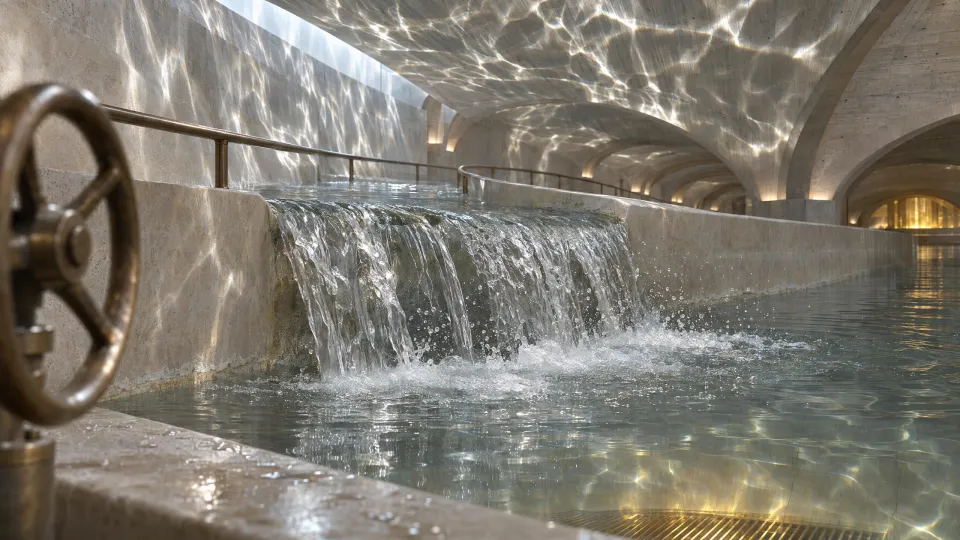
Reclaimed water comes back clean over a stone weir. Beside it is the command table, lit from within, where people make the base’s decisions.
The mark’s trailing edge is the hangar: one polished deck, one flying wing, and a line down the floor to the doors.
The first thing built
is the base’s own power,
sealed in rock below it.
Everything grows from it.
Most installations spend a century leaning on a grid, a pipeline and a highway they don’t control. This one starts underneath.
At the core. A reactor sealed in granite, a thousand feet down, carries every load on the base: the compute hall first, then everything above it.
Beside it. The compute hall is the most protected room on the base: in rock beside the core, behind copper. Everything the base’s sensors see arrives here as one picture, and the hall’s waste heat helps make fresh water.
Above it. The base’s data stays on its own network. Its one way out is the base’s own beam, from the dish on the ridge to orbit.
Power, compute, data and water each leave the reactor chamber by the shaft or by a lined gallery through the rock. Pick one to follow.
The ground under a base is acreage too. The switchyard, the reservoir and the dish each sit at the end of a gallery.
Every line that comes in from outside can fail. The base keeps its own lights on.
Food grows under light on floor one, in the rock.
Greens and strawberries, picked by machine every day.
Next: water
Used water is cleaned on site and comes back over a stone weir into the reservoir.
Nothing is piped in from outside the fence.
 Next: power
Collectors on the plain follow the sun by day. The core carries the night.
If every outside line fails, power, water, data and defence keep running for ninety days.
 What the base runs on
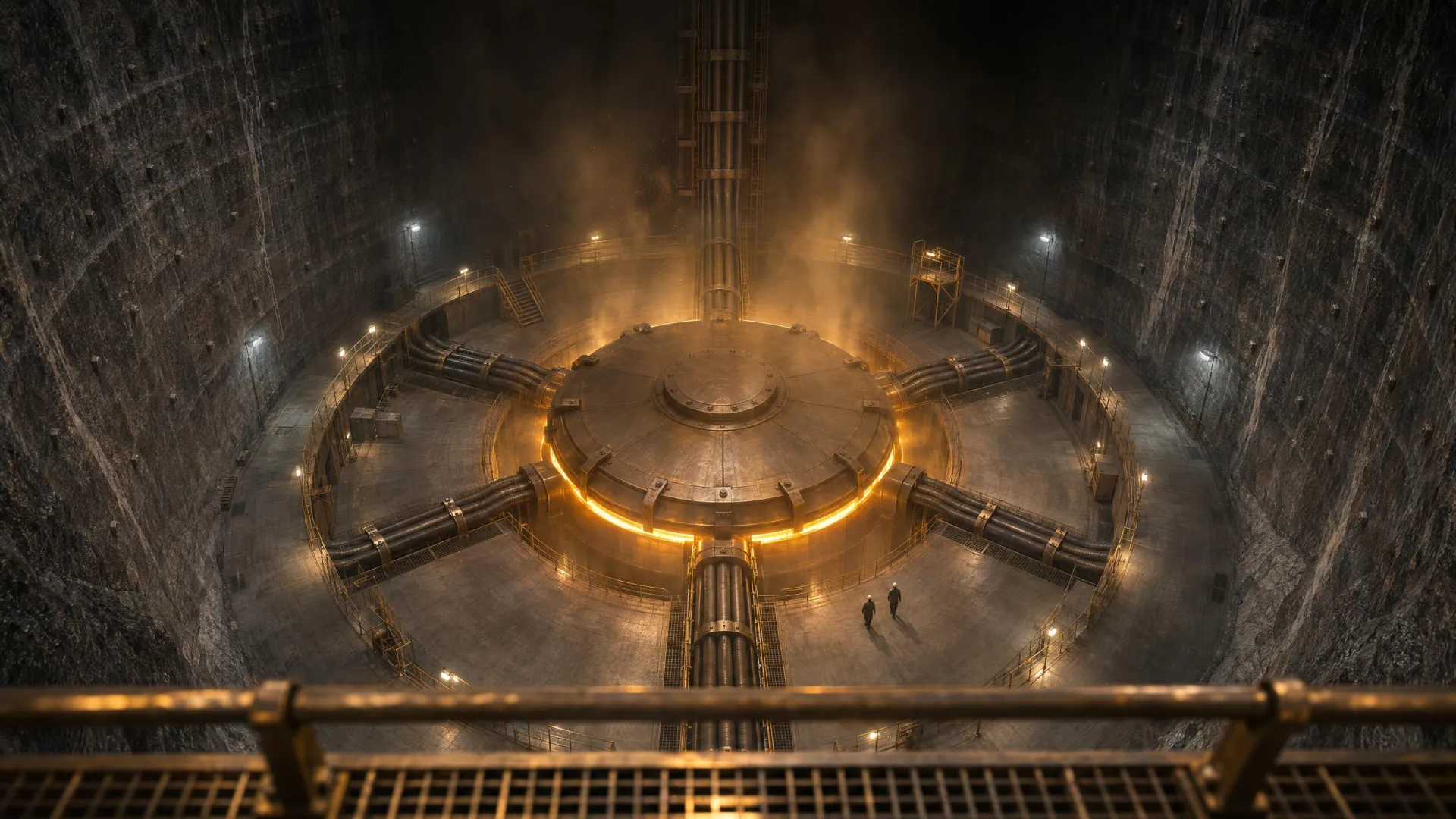
A reactor sealed in granite a thousand feet down. It carries every load on the base.
An attack will not come one way at a time. Land, air, space and the network are watched together, and each domain the base projects power into is defended too. Most nights, nothing happens.
Each layer answers a different threat. The deeper a thing sits, the more of them stand in front of it.
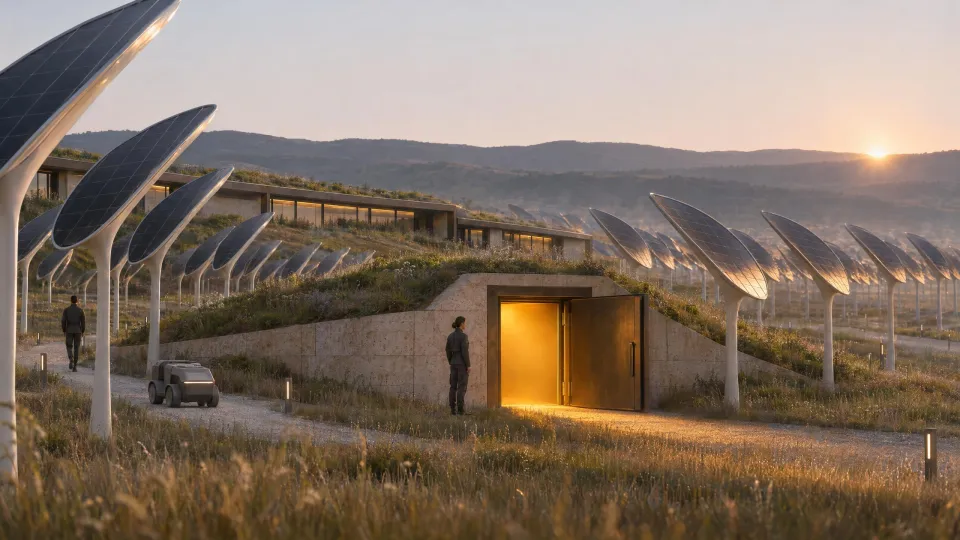
Planted roofs and a hill. From orbit there is a ridge and a few low buildings; the acreage that matters is under them.
Orbital surveillance
Sensors every thirty feet, tied together. When one trips, a drone goes to look and the ops centre makes the call.
Intrusion on the ground
No guard booth. A face is read with the plate, or with the vehicle’s own authorisation, and the vehicle never stops.
Who comes in
A ring of sensing closes over the airfield, and directed-energy defence stands on the ridge.
What comes through the air
The floors are cut into the hill and the core sits a thousand feet down. Depth is the answer to a strike from above.
Hypersonic kinetic strikes
Cyber is the first threat. Compute and the base’s data sit on their own network beside the core, behind copper.
Cyber intrusion and electromagnetic attack
One system watches every layer. When one is hit, the others close around it and machines begin the repair. A person keeps the decision.
Several attacks at the same moment
Humanoid robots move cargo, carriers run the galleries and printers lay new walls. Each is a version of something that already works today, and each frees a person for work only people can do.
Machines watch, sort and suggest. What the compute hall gathers reaches the command table as one picture, and a person standing at it makes every call that matters.
Dinner in the commons with the neighbours, the hills dark outside the glass.
See it in the teaserLong, low buildings under grass, lanes instead of parking lots. Nothing rises above the hills.
Before dawn a driverless shuttle pulls up at the house. Inside the fence, nobody drives.
The shuttle does not slow down. The gate has already read the faces on board and the vehicle’s authorisation.
The base keeps growing while people live in it: the gantry lays a fresh wall of the site’s own soil.
Lifting is the robots’ job. Checking what was lifted is still a person’s.
Forty-seven seconds, from the hangar doors to dawn over the hill. Title cards and a score; no narration.
It starts with the energy source. Flight lines, a spaceport and new missions follow as the base grows into each domain. Every base stands on its own, tied to orbit by its beam, and each one built from the template shares what it learns.
Brand guidelines